Season 2026 · Episode 4 · Sep 2, 2026
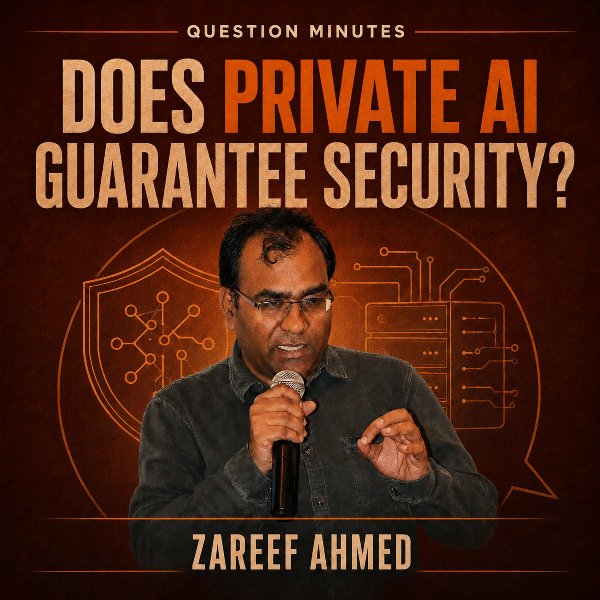
Does Private AI deployments guarantee security?
Zareef Ahmed explains why private AI deployments do not guarantee security by default and outlines the real risks and benefits organizations should understand.
Show notes
Everyone thinks going private with AI means going secure automatically, but that's not how it works. In this episode Zareef breaks down why private AI deployments only shift the responsibility of security onto your own organization instead of guaranteeing it, and what you actually need to watch out for if you're running your own setup.
- Private AI means your data and operations stay within your own network and never leave your organization's boundaries
- Private doesn't mean secure, it just means the responsibility for security now belongs to you
- Common misconfiguration risks include open ports, insecure storage, and undefined inbound or outbound connections
- Weak authentication and excessive user privileges are frequent problems, ignoring the principle of least privilege
- Unpatched operating systems, outdated libraries, and old container images can all introduce vulnerabilities
- Prompt injections and malicious documents in RAG systems are real risks to watch for
- Sensitive information can leak into logs, caches, or backups if not handled properly
- Human error remains one of the weakest links, whether accidental or intentional misuse of access
- Insecure integrations with external services and poor patching, monitoring, or incident response add more risk
- Despite the risks, private AI still offers major benefits like data privacy, better performance for large datasets, and full control over your systems
- The key takeaway is that private AI can be secure and has to be made secure, but it is never secure by default
Transcript
Hello everyone, welcome back to Question Minutes with Zareef Ahmed, and today I am going to discuss this very specific question, and the very simple one word answer is no. Private AI deployments don't guarantee or cannot guarantee the security. They only transfer the onus or the responsibility of the security from third party to your organization.
But having said that, I would like to highlight why someone would like to deploy the private AI within their organization. So what is the definition of the private AI? Private AI means that whatever you are doing with the AI is just private to your network, your organization. Your data is not leaving the boundaries of your network or your organization, and nothing is going out from your network.
And how do we deploy the private AI? In this case we deploy models within our organization on our own hardware, we set up our central systems, we set up our API policies, we set up our deployment policies within our current network. But ultimately, what is it? The security. Security is completely dependent on how you have deployed your own private AI.
What are some of the challenges that we can face with the private AI deployment within your own organization? There are many. Some of them are: you may misconfigure your server. Maybe you have enabled ports which shouldn't be enabled. Maybe your storage is not completely secure. Maybe some applications may still need access to the outside world, and those have not been defined properly. The boundaries of those outbound or inbound connections have not been defined properly.
And yes, there can be weak authentication systems and there can be excessive user privileges. Least privilege is one of the very core basic principles of any security, and it is possible that you may have missed that. And again, you may have an unpatched operating system. Maybe the applications or the packages that you are using are not the latest. They may be having some security issues. Your libraries may not be updated, or even the container images. If you are using container systems like Docker, they may be outdated or may be having some security issues.
On top of that, there may be challenges of prompt injections and sometimes malicious documents within your RAG systems if you are implementing one, and sensitive information may appear in logs, caches, or backups. Model responsibility can be undefined, or even model responses can be unchecked. Even some secure model responses may end up being in your general backups.
And on top of it, human error. Human error is always possible in any kind of system, and if you are doing private AI deployment then humans are one of the weakest links. Sometimes employees unintentionally or accidentally misuse the access, and sometimes it can happen intentionally as well. Integration with external services can be insecure in some cases, and there may be poor patching, monitoring, or incident response processes.
So ultimately, private doesn't mean secure. Private only means that now you are responsible for this.
So this question can occur: if security is not so good with private AI deployments, and everything is with us only, then why are we implementing private AI? Number one reason is privacy of your data. If you have configured your network boundaries properly, then your data is completely secure.
Performance can be another good thing. If you have gigabytes or thousands of gigabytes of data, then putting it to a third party and running your ML operations and learning from it can be really kind of a difficult task. With private AI, you have all these things within your own storage systems, within the boundaries of your organization, so that can be planned in an efficient way for better performance.
So ultimately, it is about having control, because with third parties you only have the controls which they have exposed, but with private AI you almost can control everything. That's the benefit of private AI, but never ever consider private AI secure by default. It can be, and it has to be.
Thank you. In the next episode we will talk about some other question. Till then, bye.